
|
Use
of arbuscular mycorrhizal fungi to reduce weaning stress of micropropagated Baptisia tinctoria (L.) R. Br.
Carolin
Grotkass, Imke Hutter & Falko Feldmann
Institut für Pflanzenkultur,
Solkau 2, D-29465 Schnega, Germany
Telefax: ++49-5842-493, e-mail: [email protected]
Keywords: Acclimatization, Glomus etunicatum, in vitro culture, medicinal plant
Abstract
The company „Institut für Pflanzenkultur“ adapted
micropropagation, acclimatization, field cultivation, harvest and post harvest
techniques for production of Baptisia
tinctoria on a commercial scale. Since as a consequence of weaning stress,
both the rooting rates of some clones as well as the survival rates in the
greenhouse can be as low as 60 %, different experiments were carried out in an
attempt to alleviate these problems. Best results were achieved with the
application of arbuscular mycorrhizal fungi (AMF). AMF enhanced the survival
rate of in vitro rootless and rooted
microplants. The quality of these colonized vital plants was also significantly
improved. The effects of phosphate deficient fertilizing on plant and fungal
partner was also investigated.
1. Introduction
The medicinal plant Baptisia tinctoria (L.) R. Br. is a Fabaceae native to northeastern America. Extracts of the roots are therapeutically used to stimulate the immune system. In Germany, the drug Baptisiae tinctoriae Radix is an ingredient in the immune stimulating pharmaceutical product ESBERITOX Nâ. Since collection of the plant endangers the wild stands of the plant, it‘s cultivation needed to be established. Because of the hardseededness of B. tinctoria, traditional field cultivation is not possible. Different techniques to enhance the germination rate were unsuccessful (Voß et al., 1997, Ogzewalla et al., 1997). Thus, an in vitro cultivation system was developed.
The Institut für Pflanzenkultur micropropagates the medicinal plant B. tinctoria and has been cultivating it in Germany in three-year-terms in the field. Both during weaning and in the field, there were great losses of plants of some clones of B. tinctoria. In 1995 the Institut für Pflanzenkultur propagated four clones, of which two clones had losses during weaning of up to 84 %. These two clones were of great pharmaceutical value because of their high concentrations of therapeutically active substances. However, further micropropagation of these was economically infeasible. The selection of new clones was based not only on the in vitro characteristics like high multiplication and rooting rate but also on the ex vitro characteristics such as vitality and growth rate.
The application of arbuscular mycorrhizal fungi (AMF) as a natural symbiont of many cultivated plants could be a solution for the problems of weaning of B. tinctoria. In initial experiments, colonization of B. tinctoria by AMF was greatly beneficial for cultivation of the crop, both ecologically and economically (Keller et al., 1997; Feldmann, 1999). The losses could be minimized to 4 to 10 %, fresh weight of the plants increased by 17 % and the time of acclimatization was 14 days less. Difficult to evaluate were the combined effects of plant nutrition and AMF colonization (i. e. the addition of nitrogen and phosphate to the substrate), as well specific responses of certain clones of plant species to the respective AMF strain.
Whereas colonization with AMF might increase the survival rates of many in vitro propagated plant species (Lovato et al., 1995), important for the widespread application of AMF in horticulture are the results of investigations under commercial standards. In the present study effects of AMF application on in vitro rootless microplants and on the survival rate of in vitro rooted microplants were investigated. Also different fertilizing variants were tested to better understand factors effecting establishment of the symbiosis.
With respect to the environmental aspects of the production of B. tinctoria, also proportional to the number of plants lost is the loss of plastic planting pots (up to 10,000 per year), substrate (approx. 2.5 tons per year) as well as high energy consumption (up to 24,000 KWh) and labour costs. The research project also included an ecological and economic balance sheet concerning plastic pots, substrate, energy consumption and manpower. Commercial companies will only apply AMF if the costs for the inoculum are compensated by the savings in other areas of production. Preliminary calculations show that AMF helps to optimize the micropropagation of sensitive plants.
2. Material and Methods
2.1 General mycorrhiza analyses
For the quantification of the symbiosis (Feldmann and Idczak, 1994) representative segments of the root system (30 pieces, 1 cm long) were cleared for 45 min in a 10 % KOH solution (w/v) at 90 °C. Roots were washed in 0.1 N HCl and then stained in 0.05 % (v/v) trypane blue solution (in glycerol : lactic acid, 1 : 1) for one hour. Excess stain was removed by soaking over-night in glycerol : lactic acid (1 : 1).
2.2 Inoculum production
The AMF Glomus etunicatum that was used in all experiments was that employed in the experiments of Feldmann (1998). Therefore both quality and efficiency were well known. The inoculum was propagated in two steps. In 1997, in a first step approx. 1,000 spores of strain no.12, characterised positively efficient (Feldmann 1998) were propagated in 4 l pots on Zea mays cv. Blizzard, resulting in 100 l of inoculum with 28,000 propagules per liter inoculum (Zea mays cv. Blizzard, Feldmann and Idczak, 1994). In 1998, in a second step this inoculum was propagated again on Zea mays cv. Blizzard resulting in 25,000 l with 92,000 propagules per liter inoculum. The cultivation in both steps was identical. Only the pots/volume employed differed: in 1998 the inoculum production was carried out in 340 l plots. The plots were planted as follows: 50 plants of Zea mays cv. Blizzard, 50 plants of Tagetes erecta cv. „Gelber Stein“ or 25 plants of Z. mays cv. Blizzard and 25 plants of T. erecta cv. „Gelber Stein“. As a control, the same experiments were conducted in plots without AMF inoculum.
A peat substrate (Einheitserdewerk, Uetersen, Germany) with 0.5 kg fertilizer/m³ (N:P:K, 12:0:18) was used for inoculum production. The inoculum mass production was carried out from 24th June, 1998 to 1st September, 1998 without additional light or shade. Light intensity differed < 5 % between the plots. Minimum intensity was 240 µmol/m² x s on shady days. Maximum intensity was 960 µmol/m² x s on sunny days. The minimal nocturnal temperature was not under 15 °C, the average temperature was 22 °C, on very hot days attaining a maximum of 45 °C without noticably damaging the plants. The plots were designed to be closed systems so that the plants always received an ample water supply. Each plant was fertilized weekly with 50 ml (Flory 2, N:P:K, 15:5:25, Euflor GmbH, München, Germany), the concentration being 1 g Flory 2/l for the first fertilization after 14 days of cultivation. Two weeks later the dosis was increased to 2 g/l and after another week the dosis was increased to 3 g/l. This dosis was kept until the end of production. Whereas this amount of fertilization permitted asymptomatic growth of the plants, phosphate remained the limiting factor. After 10 weeks the plants were harvested. Chemical pesticides were not employed.
2.3 Application
of arbuscular mycorrhizal fungi on Baptisia
tinctoria
A mixture of inocula harvested from the three plots (Zea mays cv. Blizzard, Tagetes erecta cv. „Gelber Stein“, Z. mays cv. Blizzard + T. erecta cv. „Gelber Stein“ (1:1:1) was applied to the plots of Baptisia tinctoria. The inoculum was tested on 8,000 plants of the four clones BM8, BM9, BK36 and BK37 of B. tinctoria. The experiments were carried out from the 15th February, 1999 to the 25th May, 1999 in a greenhouse. Temperature was kept at 22 °C ± 4 °C, no additional light was used, the humidity was > 40 %. After 3 weeks, each plant was fertilized weekly with 30 ml of Flory 2 (N:P:K, 15:5:25, 10 g/l).
Three experiments were conducted:
Experiment 1: Fifty rootless microplants of each clone in 80 ml pots in fertilized peat (Einheitserdewerk Uetersen: 1,5 kg/m³ N:P:K, 14:16:18 = 140 ppm P) and inoculated with 92 infection units of AMF/cm³ substrate (on Zea mays cv. Blizzard, Feldmann and Idczak 1994) (10 replications). Inoculation was carried out at the beginning of acclimatization. As control fifty rootless microplants of each clone were planted in the same substrate without inoculation with AMF (10 replications).
The survival rate of the microcuttings (%) and the rooting rate (%) were observed in this experiment.
Experiment 2: Fifty microplants of each clone with roots were planted in 80 ml pots in fertilized peat (Einheitserdewerk Uetersen: 1,5 kg/m³ N:P:K, 14:16:18 = 140 ppm P) and inoculated with 92 infection units of AMF/cm³ substrate (on Zea mays cv. Blizzard, Feldmann and Idczak 1994) (10 replications). Inoculation was carried out at the beginning of acclimatization. As control fifty microplants of each clone with roots were planted in the same substrate without inoculation with AMF (10 replications). The survival rate (%) was observed in this experiment.
Also a classification of „Quality“ was carried out visually. Plants were classified as „Good Quality“ if they showed significant growth during weaning and could be transferred to the field. The classification is subjectively.
Experiment 3: Fifty microplants of each clone with roots were planted in 200 ml pots with peat substrate and phosphate deficiency (4 ppm P) (Einheitserdewerk Uetersen) (10 replications). The plants were inoculated with 8.3 infection units AMF per cm3 substrate at the beginning of acclimatization. As control fifty microplants of each clone with roots were planted in 200 ml pots with fertilized peat substrate (Einheitserdewerk Uetersen: 1.5 kg/m³ N:P:K, 14:16:18 = 140 ppm P) (10 replications). The plants were inoculated with 8.3 infection units AMF per cm3 substrate at the beginning of acclimatization.
The survival rate (%) was monitored in this experiment.
2.4 Statistics
A separate variance t-test was used, if the standard deviation of two data sets was being compared. The results of the t-tests are based on the number of degrees of freedom, reduced according to the differences in the variance of data (UNISTAT 1995). If more mean values were being compared, a One-Way-Analysis of Variance could be applied (ANOVA) since the samples had similar distributions and were independent from each other. Multiple comparisons were carried out using a Tukey-HSD-Test on the basis of mediated ranks (UNISTAT 1995).
3. Results
The inoculation with AMF at the beginning of weaning improved the survival rate of rootless microplants of clone BM8 (Figure 1). The rooting rate at the weaning stage in soil substrate was increased for plants of clone BM8 following the application of AMF (Figure 1). Following our commercial propagation scheme until now, only in vitro rooted microcuttings of B. tinctoria were transferred to a soil substrate, initially rootless microplants had to be discarded, because of their low survival rate.
The application of mycorrhizal inoculum to plants of the four different clones significantly increased the survival rate at the weaning stage for 3 clones (up to 32 % for plants of clone BK37) in comparison to the non-inoculated plants. The survival rate of plants of clone BM8 was not significantly effected by symbiosis with AMF (Figure 2). Additionally, mycorrhization improved the quality of all four clones of the surviving plants (Figure 3). The visual classification of ‚Good Quality‘, an important factor for successful marketing of the microplants, was enhanced up to 24 % for plants of clone BK37.
Previous results had revealed that the symbiosis between B. tinctoria and AMF is more effective if the soil substrate is phosphate deficient (Keller et al. 1997). An experiment was designed to optimize the situation for only one partner of the symbiosis, the fungus. During an initial low-phosphate phase, the symbiosis became established, subsequently fertilization was at a normal level in order to stimulate growth and development of the plant partner. However, any enhancing effect of the mycorrhizal symbiosis on the plants of B. tinctoria that may have occurred was completely masked by the negative effects of deficient fertilization at the beginning of plant development (Figure 4). The plants were neither able to compensate for nor to recover from negative effects of the initial deficiencies.
4. Discussion
The methods used here to produce inoculum of arbuscular mycorrhizal fungi led to a high quality inoculum as defined by good horticultural practice. The experiments reported here prove the quality and effectiveness of the inoculum on the medicinal plant Baptisia tinctoria. The special mixture of three inocula produced with the same fungus on three different production systems was most effective.
The application of AMF at the beginning of weaning of B. tinctoria led to a significant increase in the survival rate. Of special interest were the clones that are valuable pharmaceutically and which have not as yet been produced economically using convential methods of cultivation, e.g. plants of the clones BK36 and BK37, of which only 55 or 65 %, respectively, hitherto survived weaning. For these clones the application of AMF should make commercial plant production economically feasible. Even the survival rate of in vitro unrooted was increased, plants which previously would not have been worth cultivating commercially. The quality of all clones was significantly improved following inoculation. The positive effects of inoculation with AMF on B. tinctoria might be due to an improved up-take of phosphate in the plant roots (Jakobsen 1995) although increased rooting of the plants was not observed.
In initial experiments with clone BM2, Keller et al. (1997) demonstrated that inoculation of B. tinctoria with AMF improved the rooting rate under phosphate deficiency, so that the survival rate of the plants was significantly increased. Application of these methods to clones BM8, BM9, BK36 and BK37 in these experiments did not lead to comparable results. Nearly half of the plants of some clones did not survive under phosphate deficiency even following inoculation with AMF.
Future studies should clarify whether the positive results attained in these experiments can be transferred to other clones of Baptisia tinctoria and eventually to other plant species.
Acknowledgements
We are grateful to the Deutsche Bundesstiftung Umwelt, Germany, for the support of the project „Application of arbuscular mycorrhizal technology in horticulture“, AZ 11842, and to our project partner, PD Dr. Christine Boyle, Institute of Microbiology, Technical University of Braunschweig, Germany. The authors wish to express their sincere thanks to Dr. Barbara Schulz for helpful suggestions for improvement of the manuscript.
References
Feldmann, F., 1998: The strain-inherent variability of arbuscular mycorrhizal effectiveness: II. Effectiveness of single spores. Symbiosis, 25, 131-143.
Feldmann, F., 1999: Mykorrhizaeinsatz im Pflanzenbau. Deutscher Gartenbau 17, 24-26.
Feldmann, F., Idczak, E., 1994: Inoculum production of VA-mycorrhizal fungi. In: Norris, J. R.; Read, D.J.; Varma, A. K. (eds.): Techniques for mycorrhizal research, Academic Press, San Diego, 799-817.
Jakobsen, I., 1995: Transport of Phosphorus and Carbon in VA Mycorrhizas. In: Varma A. und Hock, B.(eds): Mycorrhiza. Springer, Berlin, 297-324.
Keller, M., Barros, F.C.F., Feldmann, F., 1997: Growth response of in vitro micropropagated Baptisia tinctoria plantlets to microbial inoculation. In: Lieberei, R., Hagen, J. (eds.): Baptisia tinctoria, Angewandte Botanik Berichte 6, Universität Hamburg, 140-151.
Lovato, P.E., Schüepp, H. Trouvelot, A. und Gianinazzi, S., 1995: Application of AMF in Orchard and Ornamental Plants. In: Varma A. und Hock, B.(eds): Mycorrhiza. Springer, Berlin, 443-468.
Ogzewalla,
C., Harnischfeger, G, 1997: Methods for improving germination of Baptisia tinctoria seeds. In:
Lieberei, R., Hagen, J. (eds.): Baptisia
tinctoria, Angewandte Botanik Berichte 6, Universität Hamburg, S. 88-92.
Unistat Ltd., 1995: User´s Guide for Version 4 for windows. Madia Vale, UK, 376-604.
Voß, K., Harnischfeger, G., Lieberei, R., 1997: Hardseededness and germination inhibition of the seeds of Baptisia tinctoria. In: Lieberei, R., Hagen, J. (eds.): Baptisia tinctoria, Angewandte Botanik Berichte 6, Universität Hamburg, S. 77-87.
Figure 1 - Weaning survival and rooting rate of micropropagated in vitro rootless Baptisia tinctoria (clone BM8) with or without inoculation with arbuscular mycorrhizal fungi at the beginning of weaning
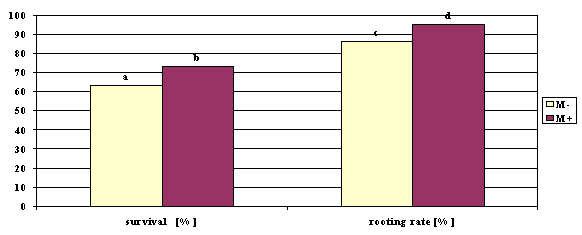
M-: without inoculation with AMF
M+: with inoculation with AMF (92 infection units of arbuscular mycorrhizal fungi per cm3 substrate
n = 500 plants per clone, 100 % = all plants potted, substrate with 140 ppm P
Survival rate and rooting rate were monitored 8 weeks after the beginning of weaning.
Figure 2 - Weaning survival of micropropagated in vitro rooted (s.o.) Baptisia tinctoria clones with or without inoculation with arbuscular mycorrhizal fungi at the beginning of weaning
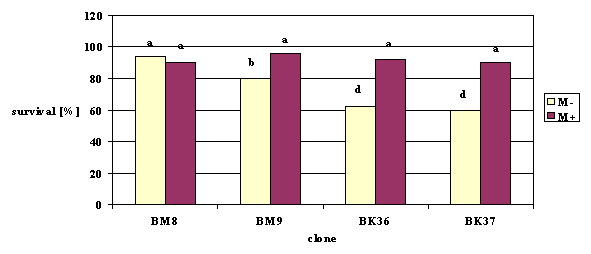
M-: without inoculation with AMF
M+: with inoculation with AMF (92 infection units of arbuscular mycorrhizal fungi per cm3 substrate
n = 500 plants per clone, 100 % = all plants potted, substrate with 140 ppm P
Survival rate was monitored 8 weeks after the beginning of weaning.
Figure 3 - Classification of micropropagated in vitro rooted Baptisia tinctoria clones inoculated or not inoculated with arbuscular mycorrhizal fungi at the beginning of weaning.
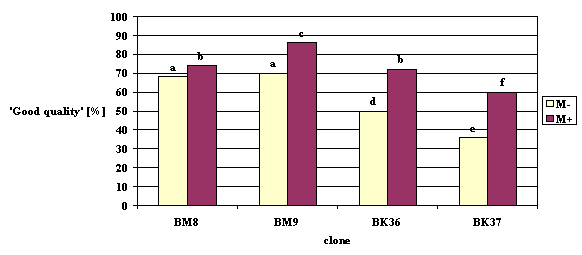
M-: without inoculation with AMF
M+: with inoculation with AMF (92 infection units of arbuscular mycorrhizal fungi per cm3 substrate)
n = 500 plants per clone, 100 % = all plants potted, substrate with 140 ppm P
Classification was monitored subjectively visually 8 weeks after the beginning of weaning.
Figure 4 - Weaning survival of micropropagated Baptisia tinctoria clones inoculated with arbuscular mycorrhizal fungi under phosphate deficiency as compared to normal phosphate fertilization
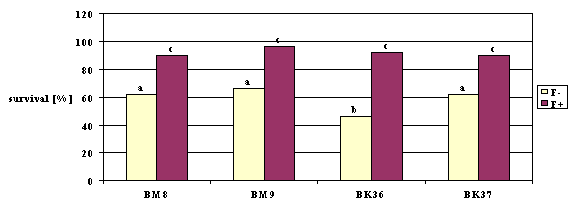
F-: 500 rooted microplants of each clone were planted in 200 ml pots (substrate with 4 ppm P) and inoculated with arbuscular mycorrhizal fungi (8.3 infection units per cm3 at the beginning of weaning
F+: 500 rooted microplants of each clone were planted in 200 ml pots (substrate with 140 ppm P) and inoculated with arbuscular mycorrhizal fungi (8.3 infection units per cm3 at the beginning of weaning
100 % = all plants potted.